Recently, Baidu Map, together with the Traffic Big Data Research Center of Tsinghua University Data Science Research Institute and Beijing Traffic Development Research Institute, released the 2023 China Urban Traffic Report (hereinafter referred to as the "Report") to gain insight into the traffic operation status and changing trends of major cities in China.
On the whole, in 2023, the popularity of public travel increased sharply, and urban traffic became more congested and busy. The report shows that: in terms of congestion, the traffic congestion index of 86% cities in Baicheng increased year-on-year, and Beijing and Guangzhou were the most blocked cities for commuting peak trips and weekend trips. At the same time, cities such as Ningbo and Jinhua achieved remarkable results in "reducing congestion"; In terms of commuting, Beijing, Shanghai and Nanjing rank among the top three in commuting time consumption list, while Beijing, Chongqing and Shanghai rank among the top three in commuting distance list; In terms of travel, the scale of 100-city cross-city migration and the intensity of intra-city travel have increased, and the average year-on-year increase of 100-city cross-city migration scale is as high as 66%; The report also released the happiness list of urban traffic lights for the first time, with Dalian and Qingdao at the forefront of the list.
Beijingers are stuck on the commuter road, while Guangzhou people are keen on traveling on weekends.
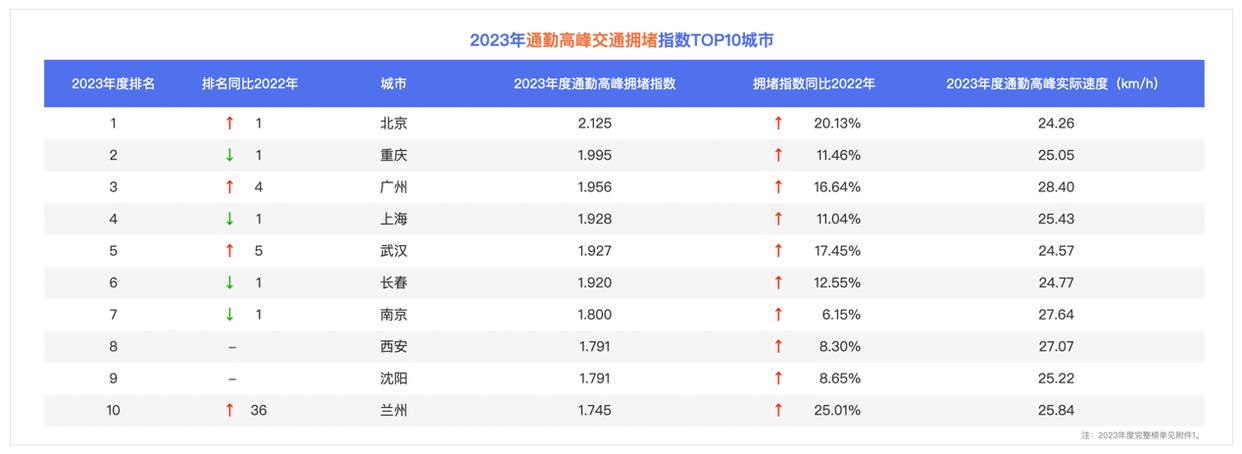
Commuting peak congestion index is an important indicator to reflect the urban traffic congestion in the morning and evening peak hours on weekdays. The report shows that Beijing’s rush hour congestion ranking rose by one place compared with 2022, surpassing Chongqing and becoming the first in 100 cities. In addition, the congestion index of the top ten cities in the commuter peak congestion list has increased compared with 2022, among which Lanzhou’s congestion index has the largest year-on-year increase, and the traffic pressure is greater.
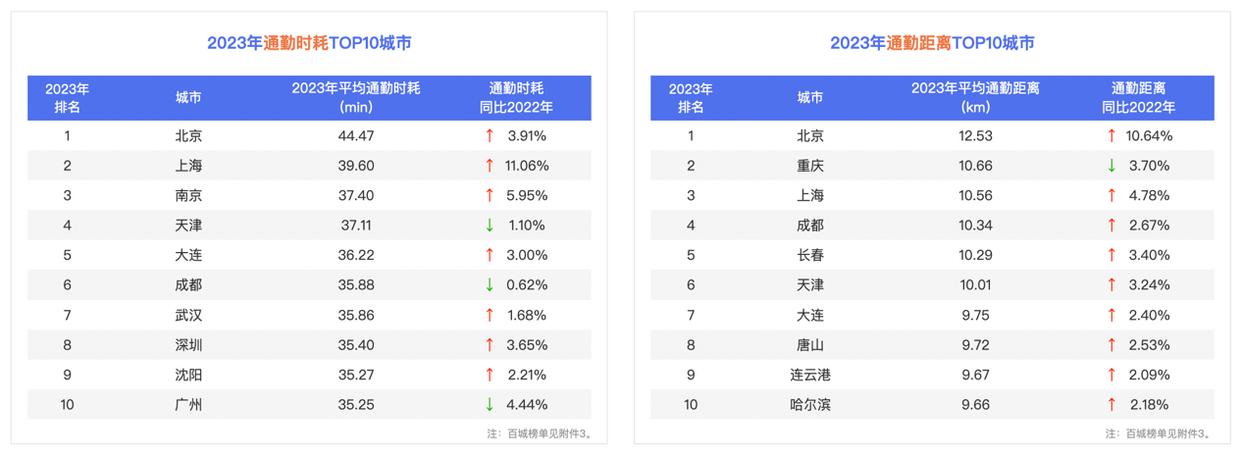
Congestion at the peak of urban commuting significantly affects its commuting cost. In terms of commuting time, two megacities, Beijing and Shanghai, rank in the top two. Among them, the average commuting time in Beijing is 44.47 minutes, and the average commuting time in Shanghai is nearly 40 minutes, both of which have increased compared with 2022. In terms of commuting distance, Beijing and Shanghai still rank high among megacities, while Guangzhou and Shenzhen are not in the top ten list. Except for going northward, although the average commuting distance in Chongqing decreased slightly compared with that in 2022, it still ranked second in the list of commuting distances in 100 cities with 10.66 kilometers.
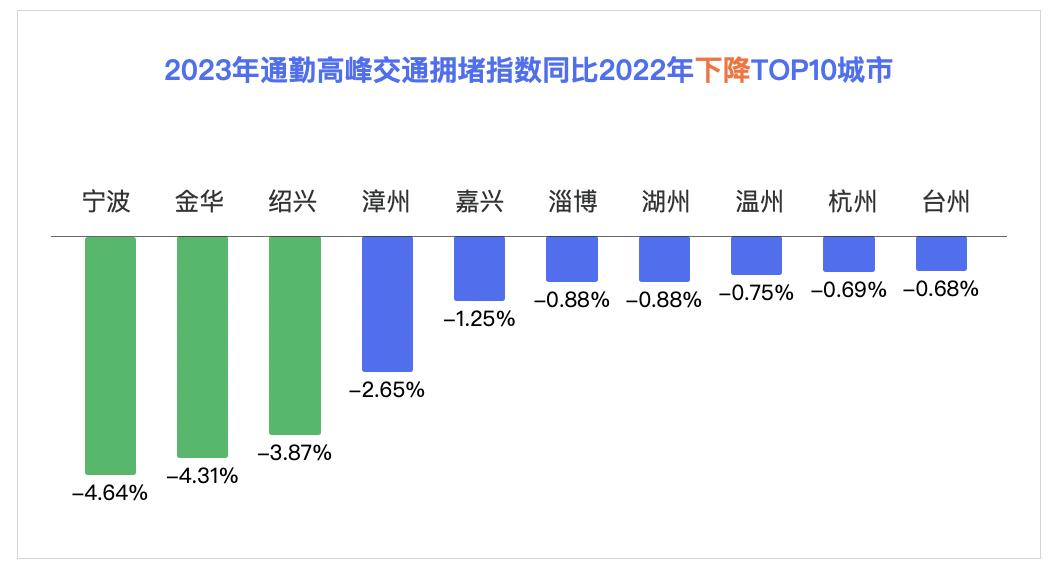
At the same time, some cities have a trend of "reducing congestion". According to the report, the traffic congestion index of 14% cities in Baicheng in 2023 decreased year-on-year, with an average decrease of 1.57%. Among them, Zhejiang has outstanding performance in many places: Ningbo, Jinhua and Shaoxing rank among the top three in the decline of congestion in 100 cities. Especially in Ningbo, the commuter peak congestion index decreased by 4.64% year-on-year, making it an "excellent student" in transportation among the members of the "Trillion Club" of urban GDP.
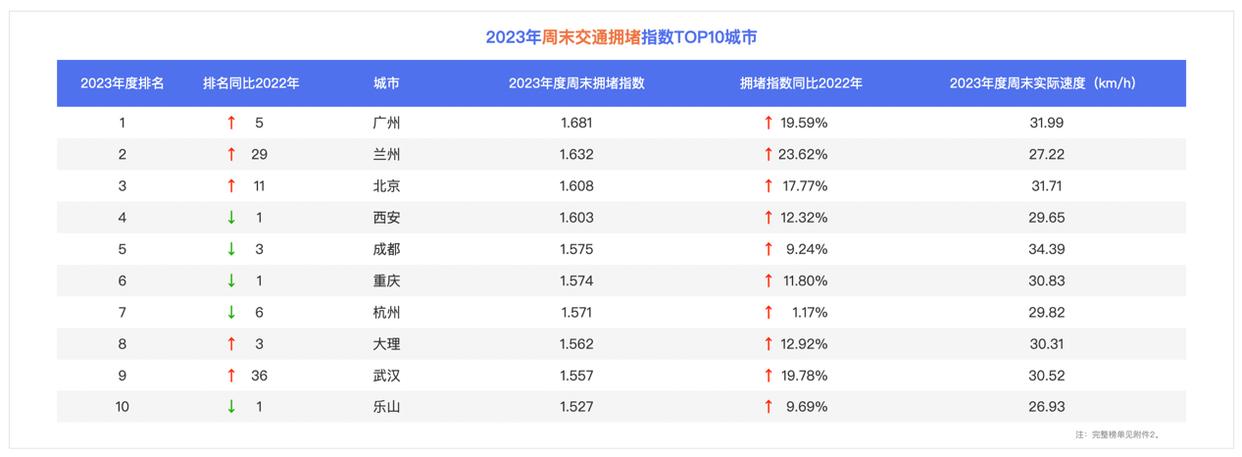
In the weekend congestion list, in 2023, the weekend congestion index of Guangzhou increased by 19.59% year-on-year, ranking five places higher and ranking first in 100 cities. Beijing gave way to Guangzhou and Lanzhou, ranking third among the 100 cities. At the same time, tourist cities such as Dali and Leshan also rank among the top ten in the weekend congestion list.
Travel in the city is full of vitality, and cross-city migration in the Yangtze River Delta and Pearl River Delta is hot.
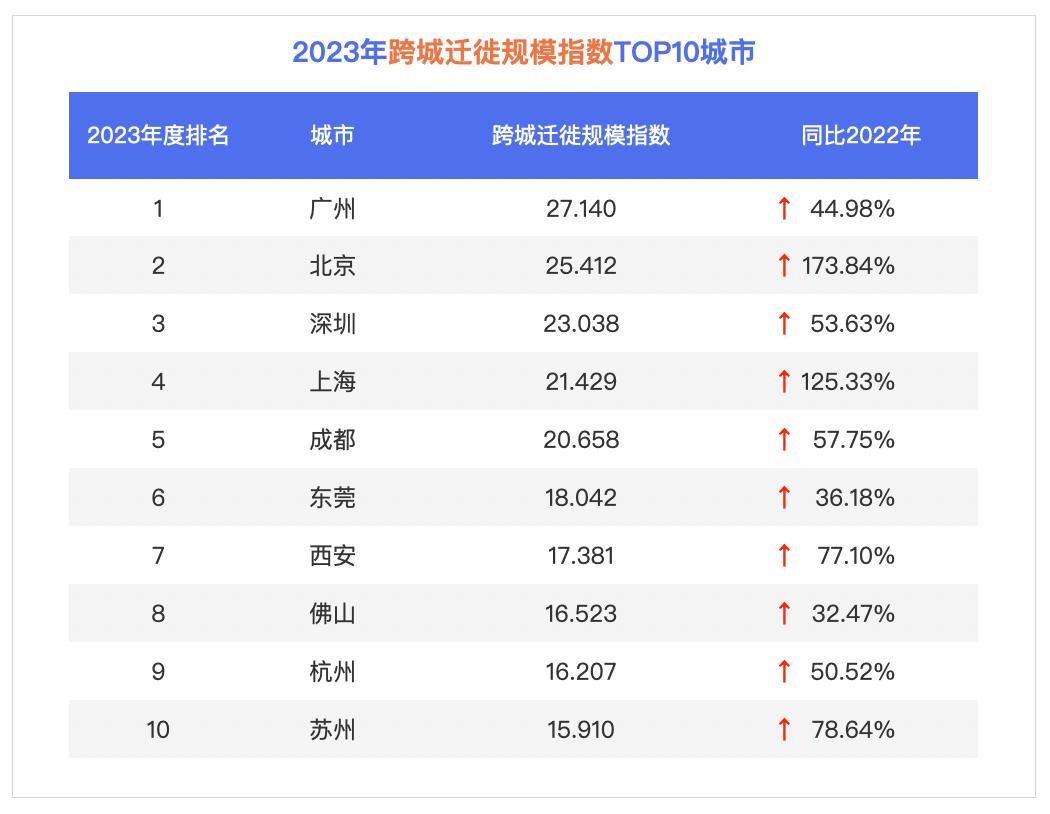
The flow of population is closely related to the coordination of urban economy and the development of transportation infrastructure. The report pointed out that in 2023, the scale of cross-city migration in major cities increased. Among them, the Pearl River Delta residents’ cross-city migration has become a habit, and Guangzhou, Shenzhen, Dongguan and Foshan all rank among the top ten in the scale of cross-city migration in 100 cities. The convenient cross-city transportation in the Pearl River Delta is an important achievement of the coordinated development of Greater Bay Area.
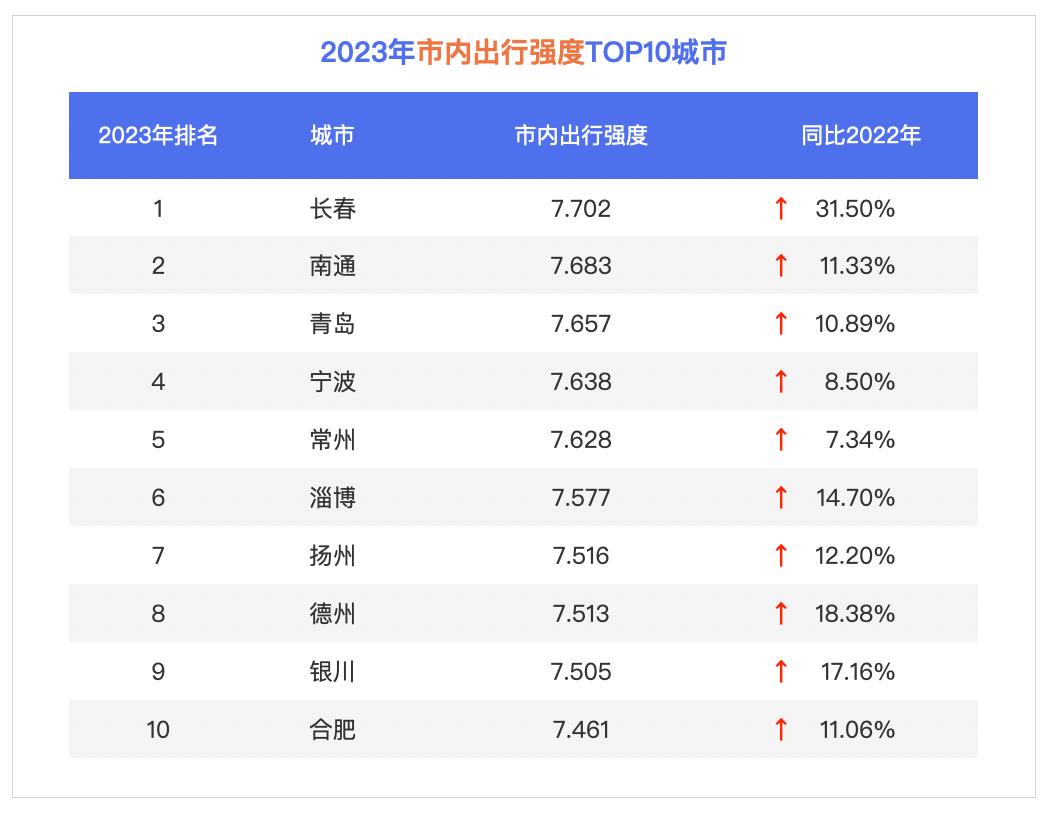
The report uses the index result of the intensity of travel in the city, that is, the ratio of the number of people who travel in the city to the resident population, to reflect the travel vitality within the city. According to the report, Changchun ranks first among the top 100 cities in the city, with a year-on-year increase of over 30%. Nantong, Qingdao, Ningbo and other local economic "top students" travel intensity in the city has also steadily increased, ranking high.
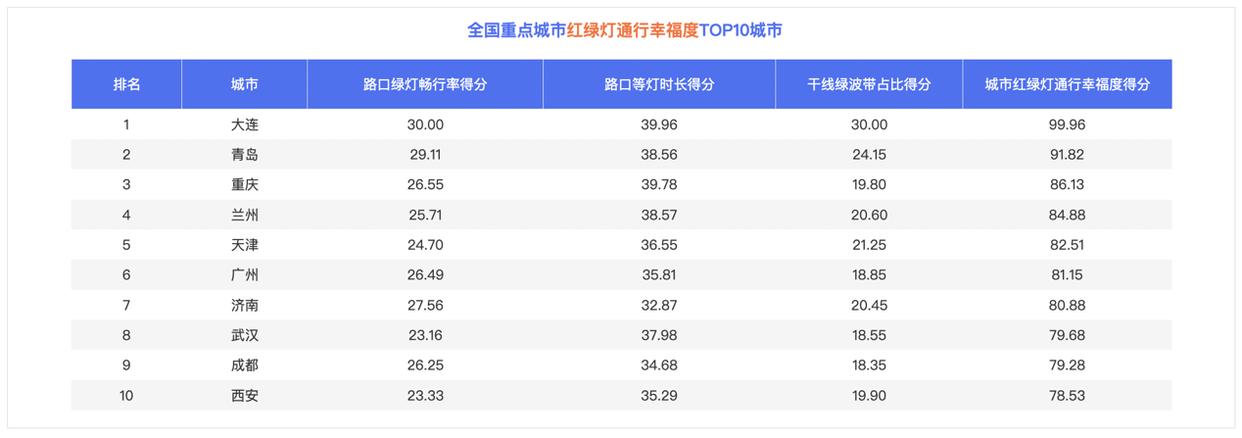
The first traffic light happiness list, led by Dalian, Qingdao and Chongqing.
In the busy urban traffic pattern, which cities have better travel happiness experience? Based on the data monitoring of 36 key cities, the report released the happiness list of city-level traffic lights for the first time. According to the report, among the key cities in China, Dalian, Qingdao and Chongqing rank among the top three in the happiness list of traffic lights, which means that under the condition of appropriate traffic flow, the probability of green light at intersections in the above cities is higher, the waiting time for red lights is shorter, and the proportion of green wave trunk lines is relatively higher. In addition, in terms of indicators of the green light traffic rate at intersections, the green light traffic rates at intersections in Dalian, Qingdao and Jinan are 60.4%, 58.9% and 56.3% respectively, which are excellent.
The change of urban traffic reflects the development of urban social economy to some extent. Throughout 2023, the heat of transportation in 100 cities has increased, and the social economy has steadily increased. In the future, Baidu Map will continue to tap and play the value of big data, and with the help of AI and other technical means, gain insight into the changing trend of urban traffic, serve users’ travel, empower industrial development, promote new consumption of cultural tourism, and help build a strong transportation country.
(Source: Elephant News)

关于作者