"Planting grass" is an intangible heritage, and intangible products become a new choice for personality expression.
Non-legacy craft
Click on some well-known e-commerce platforms, such as canvas bags, sweaters, folding fans and silver necklaces … … A unique daily necessities with "non-legacy" makes people shine. These objects, which seem to have a sense of design, are the product of the cooperation between non-genetic inheritors and designers.
At present, intangible products have not only stayed in the collection sequence, but have gradually become people’s daily consumer goods. Many young people have become "fans" of intangible cultural heritage, and "putting intangible cultural heritage on the upper body" is a new choice for young people to express their personality.
On June 8, the first "2019 Non-legacy New Economic Consumption Report" (hereinafter referred to as "Report") released on the day of "Cultural and Natural Heritage Day" showed that the potential of non-legacy consumption was stimulated, and the number of non-genetic inheritors continued to increase and the trend of youthfulness was obvious.
◆ The rise of the national tide ◆
Young people’s "planting grass" intangible products
In recent years, e-commerce model has gradually built a bridge between intangible products and young consumers. According to the Report, among the non-legacy products sold on e-commerce platforms, jewelry accessories are the most popular among young consumers, accounting for 40.7%. Online non-legacy consumers are younger, "post-80s" have become the mainstream, and the proportion of "post-90s" has increased. Geographically, Guangdong, Sichuan and Beijing’s non-legacy "fans" and "fans" occupy the top three.
The reporter looked through the messages and found that the love for the intangible cultural heritage itself or the appearance of commodity design is the main reason why many young people "plant grass". Xiao Pan, a post-90s interviewee, said that some "modern national style" costumes with design elements are easier to wear than traditional non-legacy costumes and are deeply loved by peers.
"Adding ethnic minorities or traditional cultural elements to the design of clothing, backpacks, shoes and jewelry not only enhances the design concept of the whole product, but also brings novelty to consumers. It is a very clever combination." Ma Zhiyao, director of the International Education Center for Intangible Cultural Heritage of Tianjin University, said.
Li Ziying, deputy director of the Guangdong Institute of Arts and Crafts, pointed out that most of the intangible cross-border products currently seen are relatively rough handicrafts, lacking the participation of more sophisticated handicrafts, such as Guangcai and woodcarving in Lingnan. "Guangdong’s traditional craft resources are profound, and we should do more exploration in combining with cultural creation."
More and more e-commerce platforms have joined the ranks of "non-legacy new economy". As early as May 2017, Vipshop launched the e-commerce public welfare platform "Weiai Workshop", which focuses on the non-legacy activation and inheritance. So far, it has jointly developed more than 200 fashion cross-border products. On July 10th this year, JD.COM launched the Intangible Heritage Channel, and handicrafts with regional characteristics such as Suzhou embroidery, bamboo weaving and building lamps were placed in a conspicuous position on the channel.
◆ Poverty alleviation productivity ◆
Return of craftsmen who go out to work
The reporter noted that at present, many non-legacy products are combined with poverty alleviation and have a public interest color. According to the Report, "I hope to support/help relevant non-genetic inheritors through consumption" has become an important reason why consumers are willing to buy non-legacy products.
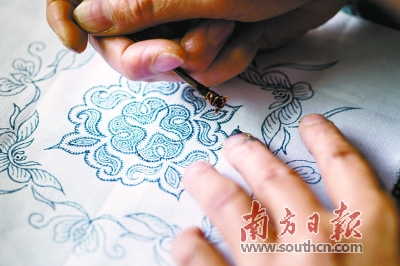
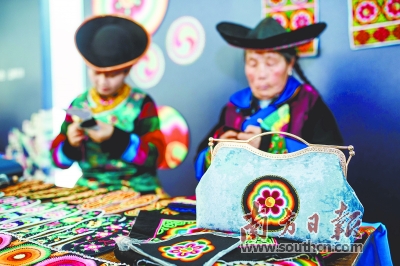
Yang Linxian, a Miao girl, changed her life. A few years ago, due to the birth of a second child, she returned to her hometown of zhijin county, Bijie, Guizhou, and made a living by driving a taxi. Yang Linxian told reporters that batik and Miao Xiu are deeply loved by local young people, and most of them also have a skill, but they have no choice but to produce and sell themselves for a long time, which is time-consuming and laborious, and their income is low, so they have to go out to work to make a living.
The business model of "e-commerce+intangible heritage+poverty alleviation" has brought new changes to the lives of these young craftsmen. At present, with the help of the local women’s Federation, Yang Linxian has become the leader of "Only Love Mom Made Guizhou Miao Xiu and Batik Cooperative", and won the brand’s Miao Xiu and Batik orders. Cooperatives seek and cultivate the non-legacy talents of batik in Miao Xiu, introduce famous designers and fashion brands, and combine the characteristics of batik in Miao Xiu to launch modern aesthetic products, which will be promoted and sold on the e-commerce platform.
Yang Linxian felt "excited and gratified" when he saw that his craft was reborn in the product. When she first joined the project, she was also a little worried about her income. She didn’t want her income to be higher than that of working outside. Driven by Yang Linxian, many craftsmen who went out to work began to return. Yang Linxian also actively participated in the training of embroidered mothers, making money, and craftsmen are more willing to pass on their skills.
◆ Running in is very important ◆
The order was changed by the embroidered bitch.
Zhang Wenying, the designer of the clothing brand "Living on the Left", recently joined the non-legacy creation.
In 2018, Zhang Wenying and several colleagues visited Zhijin in Guizhou. As soon as she arrived at the scene, she was attracted by the craftsman: "It is completely different from the professional design I made. The inheritor does not make a draft, but directly draws on the cloth with crayons. Improvised creations are vivid and flexible, and every piece of clothing and every pattern cannot be copied. "
However, the combination of fashion and tradition often needs a running-in process.
"Different from the fabrics used in industrial production, the traditional batik in zhijin county uses earth yarn as the fabric. After switching to new fabrics, embroidered women feel very strange, and even have difficulty in drawing. Designers need to provide fabrics for them to practice first. Designers consider the needs of consumers. If new fabrics can cater to consumers’ preferences, it is necessary to change the inheritors’ original habit of using fabrics. As long as consumers recognize batiks and are moved by the inheritors’ works, there will be new orders soon. " Zhang Wenying said that running-in is very important.
Aesthetic conflicts appear in the process of cooperation between clothing brand tears and non-genetic inheritors. "When we followed up the production, we found that the color matching of the original order was changed by the embroidered mothers, who felt that the traditional colors looked better. Later, the goods had to be re-ordered, and the losses were borne by ourselves. " The tone of the person in charge of the project revealed some helplessness.
◆ "Liquidation" is not easy ◆
There are still a few people who are popular by Tik Tok
Under the wave of "internet plus", short video social media platform has quickly become a popular non-legacy live communication mode.
In 2017, Pan Ren (stage name), a nuclear sculptor in Zhanjiang, Guangdong Province, made his work into a video and transmitted it to his quick hand. His exquisite skills attracted the attention of many netizens. He left the micro-signal on the platform. In the past two years, although he stayed at home and devoted himself to his skills, the number of WeChat friends has expanded from a few hundred to nearly 5,000. With such a "small circle" that likes nuclear carving, Pan people can create fine works with peace of mind and don’t have to worry about sales.
In fact, there are not a few craftsmen like Pan on platforms such as Tik Tok and Aauto Quicker.
Last November, Yu Wanlun, the inheritor of Luzhou Oil Paper Umbrella, registered the Tik Tok account "Master of Oil Paper Umbrella", and has released hundreds of short videos so far. The beautiful shots in the video, as well as the interesting interpretation of the oil-paper umbrella culture, attracted many young people to watch. Today, his oil-paper umbrella is sold out every month.
Tik Tok has become the largest non-genetic broadcasting platform in China. According to statistics, as of April this year, among the 1,372 national intangible cultural heritage projects, Tik Tok has covered 1,214, with a coverage rate of 88.48%. The number of videos related to national non-legacy projects exceeded 24 million, played more than 106.5 billion times, and received more than 3.1 billion praises.
Compared with film and television works, short videos have a lower production threshold and the widest communication base, making it easier for ordinary craftsmen to enjoy the "information dividend".
However, there are still a few non-legacy projects that are really "out of the circle" at present, and it is not easy to "realize".
He Fengting, a "post-90 s" Guangzhou girl, studied under Dong Huilan, the inheritor of Guangzhou costume making skills. As Dong Huilan’s niece, she took over her aunt’s class and tried to broadcast live. More than two months ago, He Fengting saw the recruitment of "non-legacy partners" while playing in Tik Tok, so he immediately filled out the application form, hoping that the costumes could be promoted on this platform, but the effect was not satisfactory. He Fengting said that at present, traditional industry orders are still the mainstay, and how to realize "realization" through the platform in the future will continue to be explored.
◆ Avoid rushing headlong into it ◆
Build a "small but beautiful" workshop and create it calmly
Ma Zhiyao still remembers that more than a decade ago, many experts kept writing articles in order to make intangible cultural heritage get public attention. Now, the online platform audience’s love for intangible products makes him feel that the "golden age" of intangible products is coming.
At the same time, many experts in the industry also reminded that innovation should respect the characteristics of non-legacy skills, and we should not blindly pursue "explosive" growth, especially pay attention to distinguishing from some modern handicrafts that are actually mechanized under the banner of "non-legacy".
"We have repeatedly called for handcraft to be the core of non-legacy, and it is impossible to leave the non-legacy of manual labor." Ma Zhiyao said.
Therefore, the experts interviewed are more inclined to build "small and beautiful, small and elegant" workshops. In their view, this can enable non-legacy craftsmen to complete exquisite works in a careful and calm state.
As handicrafts, craftsmen have to work longer hours and get benefits very slowly. The non-replicability of handicrafts makes intangible products have artistic attributes and the price is relatively high. Yu Wanlun, the inheritor of oil-paper umbrellas, sells oil-paper umbrellas ranging from 280 yuan to 1080 yuan. His Tik Tok is also frequently commented that "the price is too high". Master Yu responded: "The production cycle of an oil-paper umbrella is 20 days, and craftsmen have to support themselves."
The reporter found that under the wave of "non-legacy fever" on the network platform, some non-legacy products also have the phenomenon of driving up prices. "Blind premium will only make people stay away from non-legacy, and it will also destroy the newly established non-legacy consumption ecology." Ma Zhiyao believes.
In the Report, 44.3% of the respondents chose "the price is too expensive" in the survey on "Why China consumers have not bought intangible products". Consumers’ acceptance of high-priced intangible products is limited, and more than 90% consumers are more willing to buy intangible products below 300 yuan.
Ma Zhiyao is also worried that luxury intangible products may make people "only know their fashion" and forget the connotation behind it.
"Intangible creativity without stories is pale." Ma Zhiyao has repeatedly stressed that the core of creative industry is content industry, and the story behind the product and its cultural connotation. This kind of story can’t be made up by modern people, but should be based on literature investigation and restore the intangible story. He believes that experts in folk culture should also participate in the creation of non-legacy products and interpret the sources of creativity, thus helping to enhance the cultural added value of products.
Nanfang Daily reporter Wang Yueying Liu Changxin
Correspondent Chen Xiaoying Li Zuoyou
Planning and Coordination: Yang Yi Wu Qing
Photography in this column: Chen Xiaoying