Friends circle sends red envelopes to save cancer patients. Strange netizens steal donations and refuse to return them.
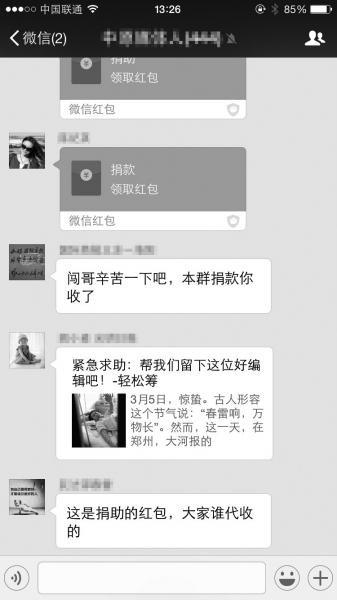
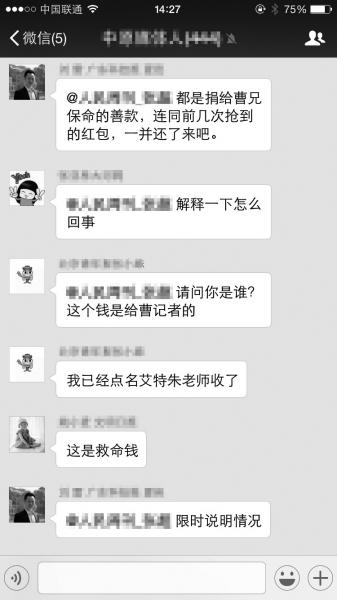
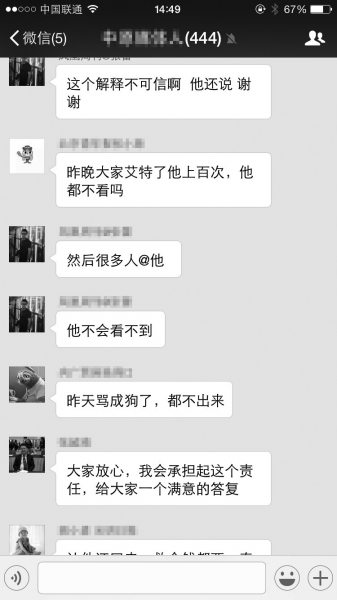
Recently, in a WeChat group, netizens donated money to a cancer patient in the form of love red envelopes. Unexpectedly, a netizen snatched a number of "love red envelopes" and refused to return them, causing many netizens to be dissatisfied. So how to define this behavior of grabbing red envelopes legally? In addition, in the upcoming first charity law in China, will it regulate related behaviors? Are the charity donation activities carried out by WeChat friends circle and WeChat group protected by law? To this end, the reporter interviewed relevant legal experts from China University of Political Science and Law and Tsinghua University.
□ Event
Many "love red envelopes" were taken away by the same netizen.
On March 5th this year, Cao Lei (a pseudonym), a 45-year-old man, was diagnosed with acute T-lymphocyte leukemia. This is a dangerous type of leukemia, which requires a large number of expensive imported drugs that are not covered by medical insurance, and also requires hematopoietic stem cell transplantation. Mr. and Mrs. Cao Lei were born in the countryside, and their income was meager. They just spent all their savings to finish the operation for their mother. Faced with the daily treatment fee of 10,000 yuan and the huge operation fee of hundreds of thousands, Cao Lei’s family was sad.
Cao Lei’s relatives, friends and colleagues have generously donated money after learning about it, and sent out help messages through WeChat friends circle and WeChat group.
At 11: 50 on March 6th, Mr. Shi, a friend of Cao Lei, forwarded the help information to a fellow villager. At 15: 17, Shao, a group friend, sent a WeChat red envelope from 100 yuan in the WeChat group and called Mr. Shi to collect it. Chen Mou, a group friend, snatched the red envelope just after it was issued, and Chen Mou returned it immediately after realizing the mistake. At this point, the red envelope was taken away by a person named "Li Chao" on WeChat. Group friends have called "Li Chao" and asked him to return the money, but he has not responded.
At about 10: 30 in the evening, after seeing the information for help, group friends Wang and Xue successively sent 100 yuan red envelopes in the group, marking that the red envelopes were donated to Cao Lei. Unexpectedly, these two red envelopes were taken away by "Li Chao", and he sent the word "thank you" a few seconds after grabbing the red envelopes.
"You have gone too far today. This is life-saving money." "I robbed the life-saving money and said thank you." "It’s all life-saving donations, together with the red envelopes that I grabbed a few times ago." The group is boiling, and the group friends have left messages asking "Li Chao" to return the money. But "Li Chao" never responded.
"This person must be driving a red envelope plug-in! !” A group of friends said. As a result, a number of group friends sent a number of small test red envelopes, and "Li Chao" basically grabbed it and replied "Thank you".
Angered, the group of friends searched online and called to verify. The unit that "Li Chao" commented on WeChat said that there was no Li Chao in the unit.
The money robbed under public pressure was returned.
At about 10 am the next day, the group friends found out through WeChat chat records that more than four months ago, a man named Li Chaonan (a pseudonym) on WeChat pulled "Li Chao" into the group. After many inquiries, the owner finally contacted Li Chaonan by phone.
Li Chaonan then repeatedly apologized in the group and explained: "Li Chao" is his cousin’s micro-signal. My cousin used plug-in software to automatically grab the red envelope, but he didn’t know that he was grabbing "life-saving money". But why drag your cousin into the group? Why is the wrong unit written in the note information? Why is there only one word difference between my cousin’s WeChat name and my cousin’s? Is "Li Chao" a "trumpet" specially used by Li Chaonan to grab red envelopes? In the face of a series of questions from group friends, Li Chaonandu did not give a positive answer.
Finally, under the pressure of group friends, Li Chaonan returned 300 yuan’s donations on behalf of Li Chao and donated 1000 yuan to Cao Lei in his own name.
□ viewpoint
Public welfare network fundraising platform is reliable
The day before yesterday, Mr. Wang, the owner of the WeChat group, told the reporter that he also suspected that the micro-signal named "Li Chao" was another account of Li Chaonan, which was specially used to grab red envelopes. Mr. Wang said that he had invited the WeChat of "Li Chao" and "Li Chaonan" out of the group and deleted several unfamiliar WeChat accounts.
"I think this is an accident and it is difficult to avoid." After the incident, Mr. Wang, the group owner, had a new view on the love donation activities in the circle of friends and WeChat group. "I think that charity donation activities in WeChat group are easy to be confused, statistically troublesome, difficult to produce snowball effect, and similar red envelopes will be robbed occasionally. Therefore, similar activities will be encountered in the future, and online fundraising platforms such as Tencent Public Welfare will be a more suitable channel." Mr. Wang said.
Mr. Liu, another manager in the group, told the reporter, "Li Chao can grab more red envelopes than 300 yuan. We often send red envelopes in our group, and he can grab every red envelope. It is estimated that he has grabbed a total of 10,000 yuan."
"There is no way to prevent it. There are so many people in each group and people of all colors." Mr. Liu also said that he felt that this kind of thing could not happen in his own group before, because the group’s entry examination was strict, and the people who could enter the group were basically high-quality people.
Then, whether it is necessary to rely on charitable organizations to carry out charity donation activities afterwards, Mr. Liu expressed his concern: "I am worried that these charities are unreliable, that the supervision is not open and transparent enough, that the whereabouts of donations are unknown, and that some charities will charge a certain proportion of office expenses."
Whether it constitutes a crime depends on the specific circumstances.
The reporter interviewed Ruan Qilin, a professor at China University of Political Science and Law, about whether Li Chao’s behavior violated relevant laws and regulations.
"This kind of behavior of making money by making donations with love is quite immoral and should be condemned first." Ruan Qilin said that if the WeChat red envelope is a donation to a specific person, then the owner of the money is the donor and the recipient. In this case, grabbing a red envelope is against the will of others to obtain other people’s property. If it constitutes a "large amount", it generally exceeds 2,000 yuan, which is theft, just like stealing the money in the donation box.
At the same time, Ruan Qilin pointed out that "a large amount" is a relative concept, which needs to be determined according to the different economies of different places. The general standard is about 2,000 yuan.
"If the amount is less than 2,000 yuan, it should be theft, then it violates the Law on Public Security Administration Punishment and should be given administrative punishment for public security. If you steal a red envelope worth three or four hundred yuan, then the punishment is relatively light. "
However, Ruan Qilin also said that WeChat grabbing red envelopes is a new thing in the Internet era. People who grab red envelopes for donations may be a little child’s play. They feel that they try to grab them with plug-in software, but they don’t realize that they are stealing other people’s life-saving money, so their subjective malignancy is not great.
"Subjective malignancy is not big, and the amount does not constitute a large amount. It does not reach the level of conviction. Whether it violates the Law on Public Security Administration Punishment, I think there is room for consideration, depending on the specific circumstances." Qi Qilin said.
Donations from friends circle are not called charitable donations.
On March 16th, the draft charity law will be voted at the closing session of the National People’s Congress. Are the charity donation activities in the circle of friends and WeChat groups protected by law? Will the draft charity law regulate such behaviors as "Li Chao" grabbing red envelopes?
Wang Ming, member of Chinese People’s Political Consultative Conference and president of Tsinghua University Charity Research Institute, told the Beijing Times reporter that the draft charity law did not clearly stipulate the fundraising behavior of friends circle. Charitable fund-raising is a property activity with charitable organizations as the main body and for charitable purposes, which is regulated by the draft charity law. The charity donation activities for friends and relatives in the circle of friends and WeChat group are not called charitable donations. This is a voluntary act and belongs to the nature of donation. This draft does not involve such donations, but deliberately evades them.
"Launching a love donation activity in the WeChat circle of friends cannot be said to be illegal, but it is not protected by charity law. Once there is a problem, it must be solved by other laws. For example, if the beneficiary refuses to accept the donation, and there is a contractual dispute over whether the donation occurs, it must be solved by contract law. If the beneficiary uses the donated money in other places, it will be solved by criminal law and other laws. "
Wang Ming also believes that the WeChat circle of friends is a semi-closed circle, and there is no effective means to supervise the donation activities in the circle of friends. In this case, appropriate evasion is necessary.
When talking about the incident that "Li Chao" snatched the red envelope for donations, Wang Ming said: "This incident does not involve charitable organizations and does not belong to the behavior regulated by charity law. It is recommended to deal with it through other legal channels. "
Wang Ming believes that if the group wants to do similar fund-raising activities frequently and wants to be protected by law, then it is recommended to apply for becoming a charity organization or find a charity organization to cooperate. "If you don’t want to do either, then the risk of this behavior will be borne by yourself."
Every charitable donation must be made public.
Then, if an individual encounters difficulties and needs to solve an urgent need, what can he do besides asking for help from a circle of friends? Wang Ming said that there are many charitable platforms in China, such as the official chinese social organizations website of the Ministry of Civil Affairs and the unofficial platform such as the Foundation Center website.
According to Wang Ming, there are more than 520,000 charitable social organizations in China. The information of these social organizations can be obtained at any time through windows, websites, friend introductions and other channels, and the application process is simple. This year, the threshold will be greatly lowered, and more charitable organizations will emerge.
"If you are in a hurry, the easiest way may be to get the money in 5 minutes, such as finding a platform for micro-public welfare and a platform for free lunch. Go directly to the platform to talk about the situation, and it will take only a few minutes to start raising money. Of course, the money will go to charity first. The draft charity law stipulates in great detail how to disclose charity information, and every money must be made public. " Wang Ming said.